
QK Alice Duo
I bought a split keyboard in Vietnam and come with it are some thoughts and ideas

In my last blog post, I discussed Vietnam's unique position in the world's geopolitical theater. One point I forgot to mention is the absolute advantage of being a neighbor to China and benefiting from its manufacturing powerhouse.
I was at the center of Lazada’s peak in 2017. I worked on team 911, which oversees escalations from business offices in 7 south east asian countries, as well as the one cross-border business we had in Hong Kong. I was also part of the migration to bring the Lazada platform onto Alibaba tech in early 2018 and worked inside Alibaba’s Global Operation Center (GOC), under Ali core infrastructure. This was before the crackdown on Jack Ma. Back then, Alibaba was the center of Chinese e-commerce. and GOC oversees all aspects of business within Alibaba. It’s the C-level single point of entry into all things worth paying attention to: critical government office onboarding to Aliyun (Alibaba Cloud), the sales of Taobao and Tmall on 11-11, the growth of Alimama, or the acquisition of Hema Fresh, ele.me. We are also quite close to the integration post-acquisition of Alibaba’s strategic international assets: PayTM in India, Trendydol in Turkey, Daraz in Pakistan, and Nepal. If you look at it from Google Maps (or Alibaba’s Amap), you can almost pin them exactly to how the Belt and Road initiative was being pushed forward around that time.
Long story short, I think I am uniquely qualified to tell you how advanced China was in 2018, and they haven’t stopped getting better for the last 8 years. Their cars are now in the EU, selling with a huge margin. Their solar and battery tech is second to none. And let’s not forget to mention how most electronics, smartphones, are still coming out of Shenzhen today despite waves and waves of trade war.
Knowing all these, one of the things I tried to explore during my 46-day trip in Vietnam was what it would be like to start a business in Vietnam, knowing these advantages. Little did I know that many Vietnamese did exactly that for the last decade.
Past Attempts
While exploring different ways of taking advantage of the relatively open trade between Vietnam and China, I stumbled upon 2 product branches that are absolutely unique in terms of quality, quantity, and price. One was office equipment: ergonomic chairs, tables, mechanical keyboards, mice, you name it. Second was audio equipment: headphones, speakers, DAC, microphones, etc…
Having a two-year-old simply means that the time I can spend on an over-ear pair of headphones would be absolutely minimal. So I decided to try buying a mechanical keyboard as a way to get a feel of the products.
My journey started with several threads on ChatGPT filtering for options. A couple of years back, I tried to buy the split keyboard. My requirements are:
Wireless. This is important front and center. My current keyboard is an Anne Pro 2 using Low-powered Bluetooth. Not having the wire helps so much with my desk setup. My posture improved as well since I can move the 60% keyboard to all different places.
Swapable. I do prefer to experiment with different types of switches and keycaps, so hotswap is a big deal for me. And that brings me to the next requirement, which is also quite hard:
Fully assembled. With a toddler on my hand and AI Coding agents on my neck, I don’t have the time to solder and socket the raw board. Whatever I am getting needs to be fully assembled out of the box.
In the Western world, I tried to solve these constraints several times:
Kinesis Advantage360 Pro. I actually tried to place an order on this a few years back, and they were completely out of stock back then. I had an option to buy it through some trusted contact in US and pick it up there in person when I visit, but (a) the price was bonkers ($500 before shipping and tax) and (b) some reviews came back stating the Bluetooth connection can run into issues from time to time. So I never pulled the trigger.
Aurora Lily58. This was when I found out that the folks at splitkb.com are actually based in the Netherlands, where I live. It was an absolute joy for me to learn that I can put battery and Bluetooth modules on the 2 halves of the Lily. I spent my hackathon prize on half of the kit, and bought the rest out of my own pocket. I got my soldering kit from Amazon.nl. But then reality hits hard: I would rather spend time with my 1-year-old daughter at the time, helping her crawl and walk, rather than in a room by myself soldering the board. I tried hitting up some splitkb community members in NL for a soldering/assembly service, but nobody responded. The boards, plates, and cases are still sitting in a box behind me today, unopened.
The Shop
After uploading my keeb brain into ChatGPT, it was very helpful in pointing me toward a keyboard shop located in Ho Chi Minh city with the QK Alice Duo available. The shop is about 30-40 minutes scooter ride from where I live, so not too bad.
But before I went to the shop, I was able to hit them up on Facebook Messenger and ask questions about stock availability. They were able to give me a price and time estimation for a fully assembled board, all without having to leave my bedroom.
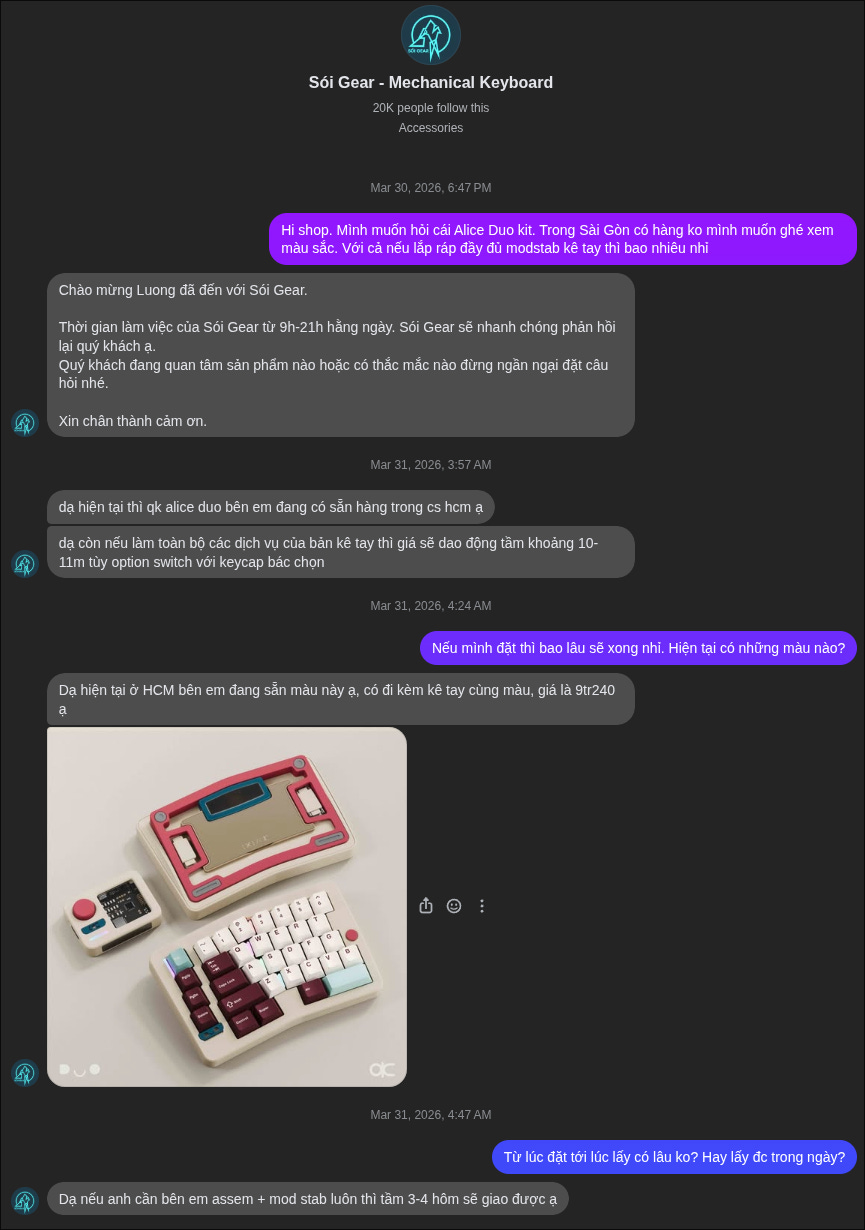
So the stock kit is 9.2mil VND, which is 300 EUR / 350 USD. Assembly, mod stabilizers, switches, and keycaps will push the damage to around 11mil VND, 355EUR / 420 USD.
Let’s recap: a kinesis is a plastic-built, not hot-swappable, and comes at the risk of Bluetooth unsynchronized, and is priced at 500 USD. Alice Duo had a full metal frame (3KG) and came with its own high-polling rate wireless buck. You get to pick the keycap and switches you want, the color you need, and the cost is still almost 20% cheaper. Absolutely crazy.
I decided to drive to the shop in person. Later, my wife reminded me that it’s relatively rare nowadays to do so. Most of these shops do shipping with high reliability. Some would even book a Grab driver to ship the goods to you within minutes, so you never have to leave the house yourself. But knowing mech keebs, I want to experience things in person, and I went anyway.
Turns out it was a good decision. The shop has several choices of switches, and they insisted on knowing the switch heights beforehand to assemble to stablelizers. While I could not find a set of keycaps to my liking, I was able to settle on the “WS BigLucky Switch-Tactile” switches.
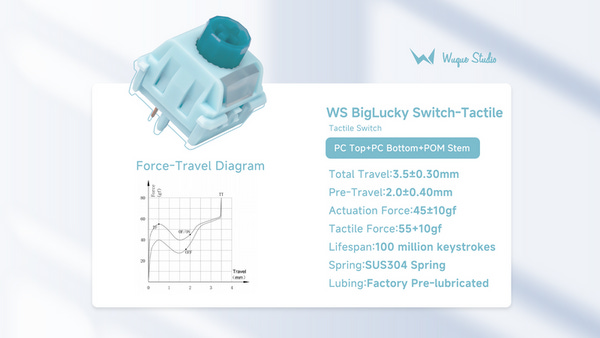
I do prefer tactile over linear, as I don’t game much nowadays. But what won me over was how solid the round cylinder is. Unlike typical cherry switches, where the stem can wobble around the housing of the switch, this cylinder design evenly distributes the down force to all the edges of the outer box; thus, no wobbly feeling. And you may have guessed it, WS is https://shop.wuquestudio.com/, a Chinese brand. The tactile of these switches is definitely a bit lacking vs the traditional MX/Gat brown though. I think I may switch these out for a set of Kailh Pro Purple in the future to get a bit more bump. I also checked out several of their keycap sets, but I feel a bit disappointed with the print quality.
With that set, they gave me the final bill, and I put half the money down to get things started.
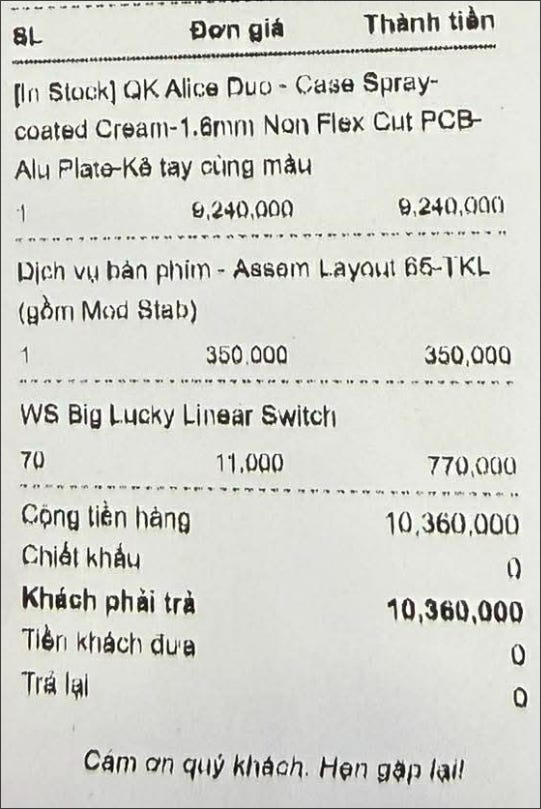
So that’s 335 EUR / 393 USD for the A-Z product and service.
The keeb
A few days later, I got a call from the shop that the keyboard was ready to pick up, and I made my way there. And to my horror, it’s not just the split keyboard but a giant box with a ton of goodies inside.
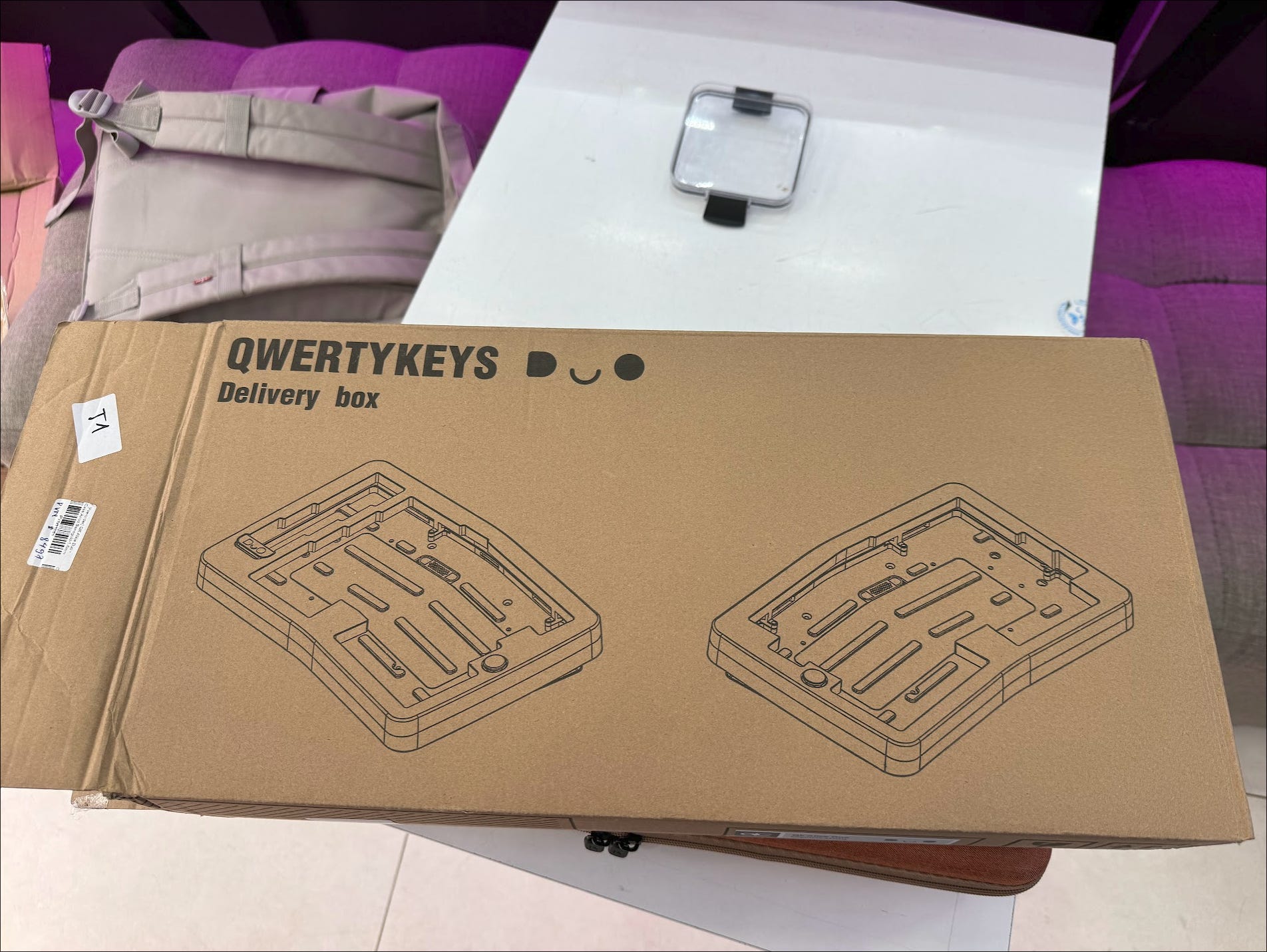
Ditching the giant cardboard box is a long orange QK case. It’s taller than my backpack, which has my MacBook Pro inside. The case contains the 2 assembled halves of the keyboard, the wireless buck, as well as a pair of metal-frosted acrylic height-adjustable palm rests, and some misc goodies like key pullers, screw driver, stab-mods leftovers.
I prepared a cheap, 250kVND (9.5 USD / 8EUR), PBT blank grey keycap set. The nice thing about this set is that it has all the special space keys needed for a split setup. This acts as a temp space holder until my endgame is shipped.
Here is the final product on my desk back in NL.
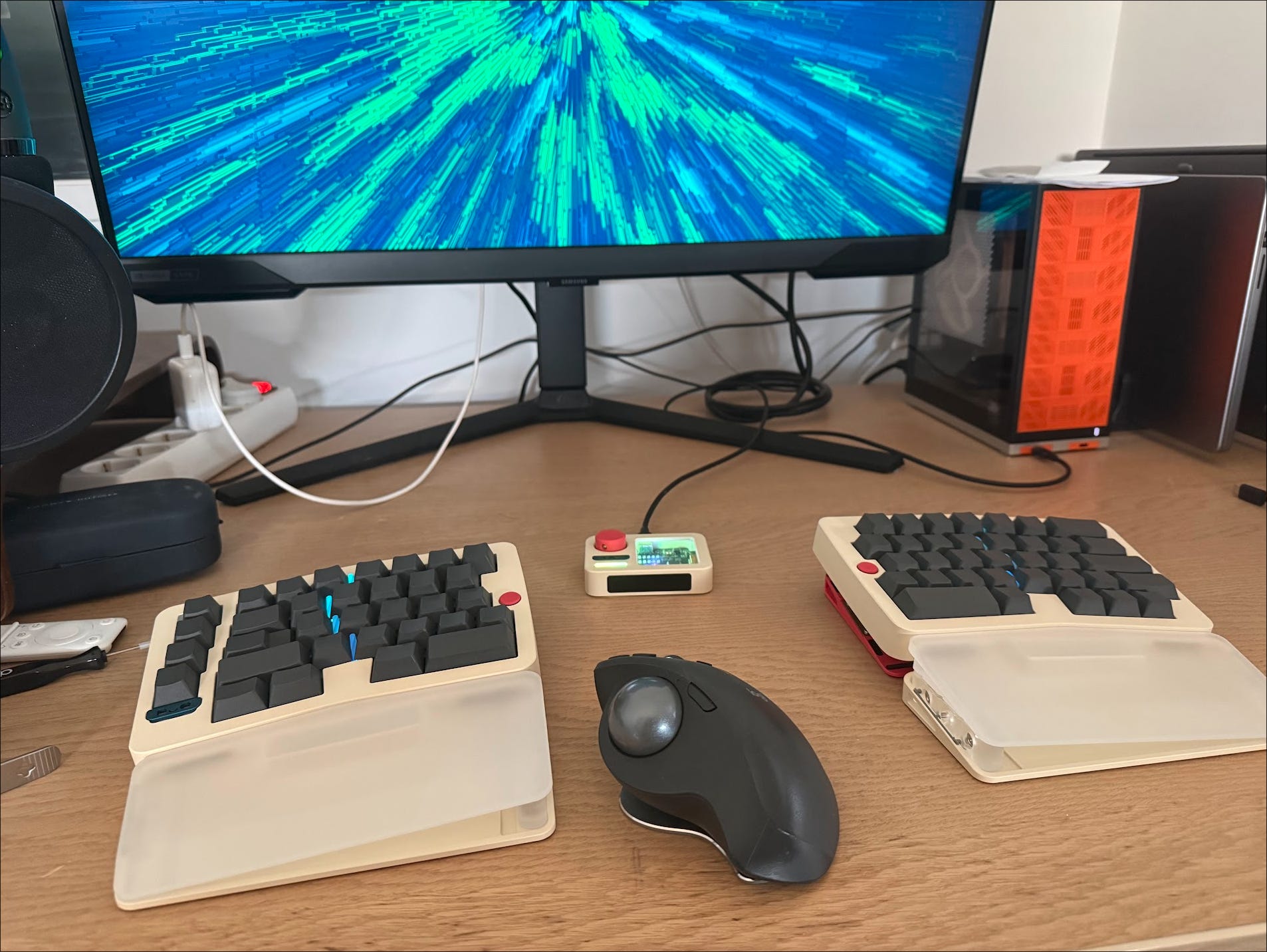
The keyboard takes a day to get used to. Blank keycaps definitely made discovering the keys a bit more challenging, but once I got the official QK Notion documentation opened, things got going pretty quickly.
Vibes
Built quality: 10/10.
This is not my first metal case keyboard, but hand carried these through 2 flights back to the EU because the battery inside definitely put some pain on my and my wife’s shoulders. W wife!
Key layout: 7.5/10.
The curve is easy to get used to for my hand size. But the stepped caplocks are a bit annoying, especially when you consider the stem position is determined by the switch position, which is not adjustable. I dislike the extra column on the left of the L half. I often reach for them accidentally while trying to locate CTRL / Shift / Caps.
Tenting: 9/10.
The strong metal frame made the angle feel solid like a brick. The palm rests can also be configured to switch between flat and tented positions, very clever.
Connectivity: 9.5/10.
This is not running on Bluetooth. The 2 halves connect to the buck using a custom wireless, and the buck connects to the PC using USB. As a result, they are relatively more reliable to operate with the Framework Desktop sketchy Bluetooth stack on Linux. The Buck design is also clever: a volume knob with some LEDs exposed from the naked board is a cheap but cool-looking solution.
Damage: I feel incredibly good spending 400 bucks on this as opposed to 500 bucks on the Kinesis. I used the saved money on a new keycap group buy: GMK Cherry Love
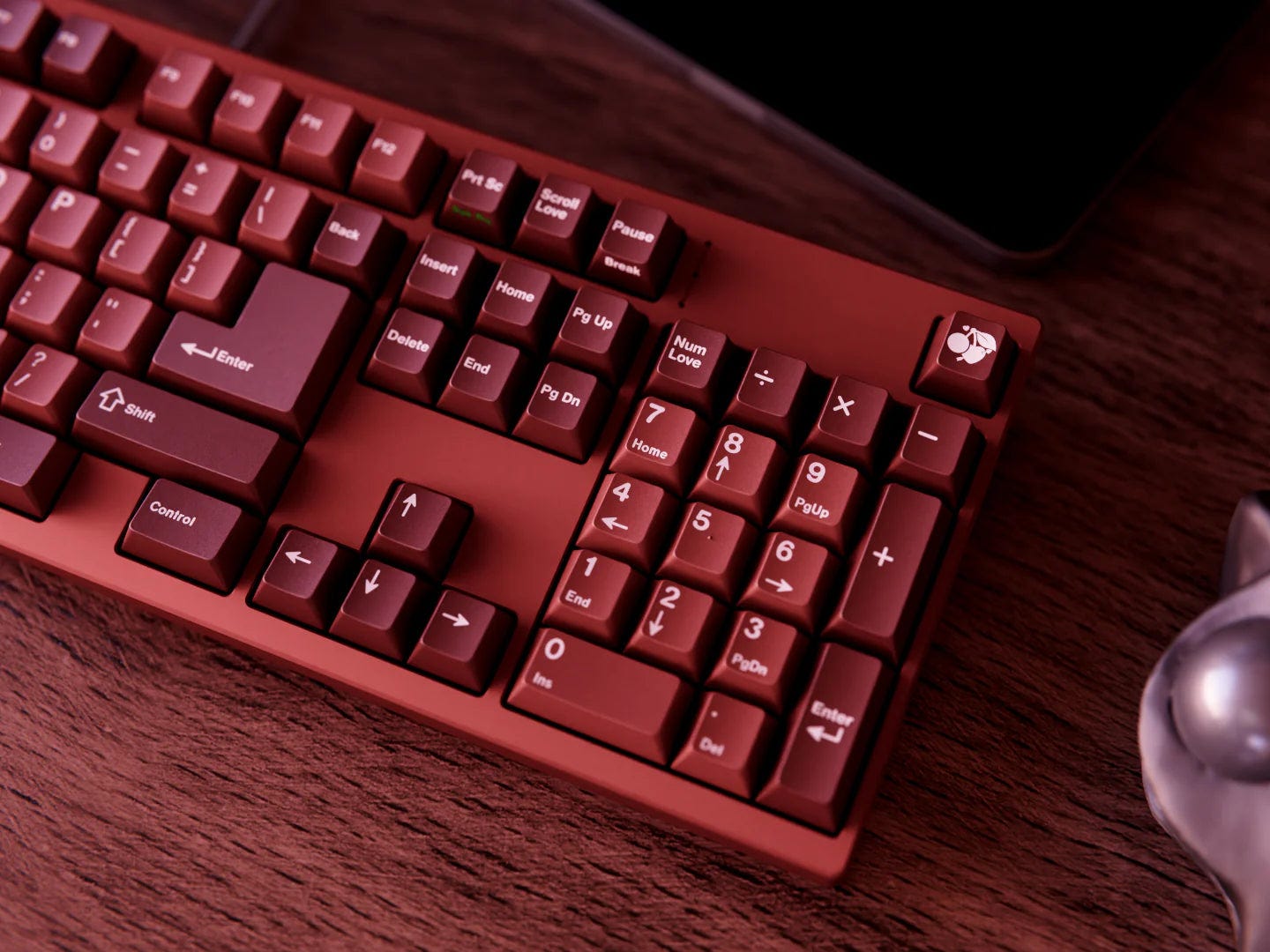
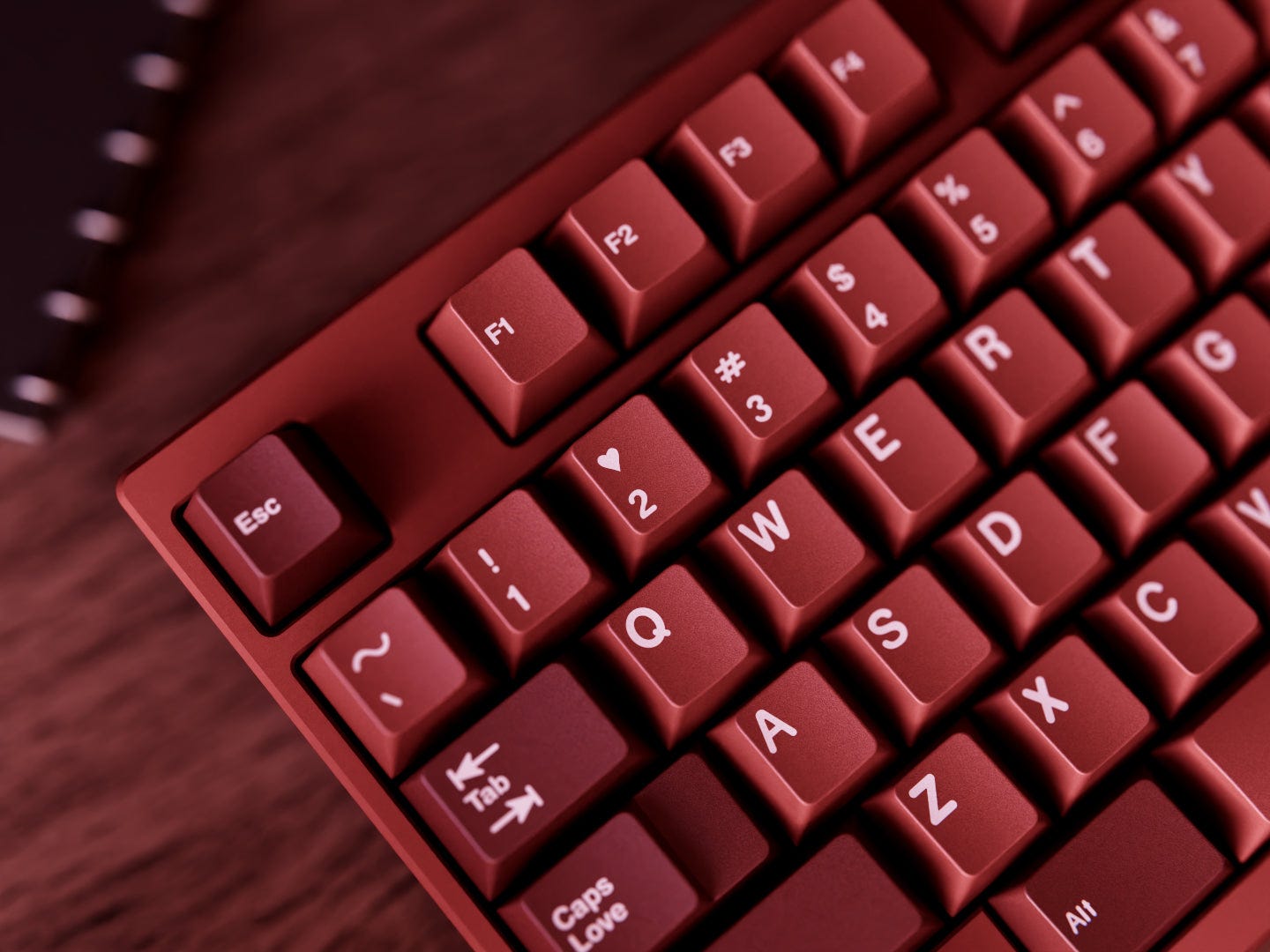
This is expected to ship in Q2 this year, and I cannot wait to put it on my QK Alice Duo.
Is this endgame yet?
Close.
Not about keyboards
I should also mention that during the trip, we found that Lazada is now shipping Taobao and Tmall goods directly from China to Vietnam. Game changer! We got our in-laws a coffee grinder from China. The in-laws live in Vinh, Nghe An, not one of the major cities, but they still get it shipped to them within a week. There was a bit of damage to one of the add-ons due to shipping, but that’s irrelevant to their use cases. And according to my wife, the price was amazing for the quality. Similar to Alibaba-Lazada, Tiktok, and Shopee, e-commerce platforms all have their own cross-border strategies to compete in the South East Asia market, an absolute win for the local consumers.
All of these were very different back in 2018. The Vietnamese government back then shielded the domestic markets from Chinese goods. While working in Lazada, I vividly recalled that Tmall/Taobao were able to penetrate Thailand and Malaysia but not Vietnam due to the strict import policy at the time. I recall we struggled a lot to ask our Chinese counterparts to help us shop for the latest Xiaomi laptop during 11-11 sales back then.
All these guardrails are now gone. The trade between China and Vietnam got a lot easier, and it does not stop at just keyboards, headphones, and coffee. It’s also real estate, tech, battery, energy, rails, and EVs, some of the core foundations for the ambitious GDP target.
Did you know that Tesla is not the only battery manufacturer in town? Here in the EU, we are getting spammed with ads about buying solar and a house battery solution to weather the future energy crisis. I actually looked into a few options to start a residential/commercial energy backup solution business in Vietnam and was surprised by how many sourcing options there are compared to the West. I do think my thesis could be a strong hedge against the global rise in energy demand, but I am not based in Vietnam to execute it. Excuses, excuses.